Book a Demo burger-menu-icon
Book a Demo

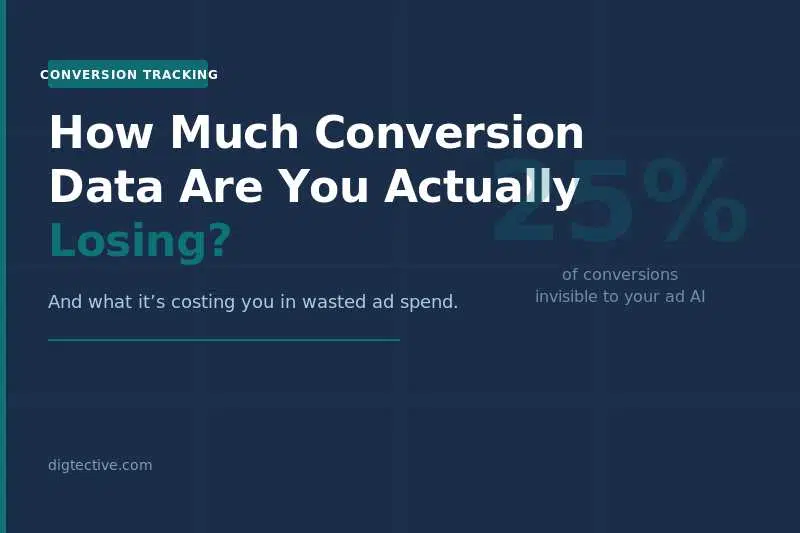
How Much Conversion Data Are You Actually Losing? (And What It’s Costing You in Wasted Ad Spend)

How Much Conversion Data Are You Actually Losing?

You think you’re spending €10,000 a month on ads.

You’re not. You’re spending €10,000 but making decisions based on €7,000 worth of data. The other €3,000 is flying blind.

That’s not a metaphor. It’s what happens when your conversion tracking is broken. And right now, for most businesses running paid ads on Meta or Google, it is broken quietly, invisibly, and in ways that get worse every year.

Here’s what’s actually happening, what it costs you, and what you can do about it.

The Tracking Gap: Why 20–30% of Your Conversions Are Invisible

When someone clicks your ad and converts, a chain of events is supposed to happen: a signal fires, your ad platform records the conversion, and the algorithm learns from it.

But somewhere in that chain, for a significant portion of your customers, the signal never arrives.

The reasons stack up:

iOS 14.5 and beyond. Apple’s App Tracking Transparency framework, launched in 2021, cut the signal rate for Meta pixel events by an estimated 20–40% for iOS users. And iOS users are not a niche — they are often your highest-value customers.

Cookie blocking and browser privacy settings. Safari has blocked third-party cookies since 2017. Firefox followed. Even Chrome users increasingly use privacy extensions or settings that prevent pixel tracking. The result: a growing share of desktop conversions are also invisible.

Ad blockers. Roughly 27% of internet users run ad blockers, many of which also block tracking pixels.

Long sales cycles. If your customer clicks an ad on Monday and converts on Friday — or in three months — the pixel event fires in a completely different session, or not at all.

Add it up: independent studies and first-party data from tracking platforms consistently show that 20–30% of actual conversions never reach your ad platform. For B2B companies with long sales cycles, or businesses in markets with high iOS usage, that number can exceed 40%.
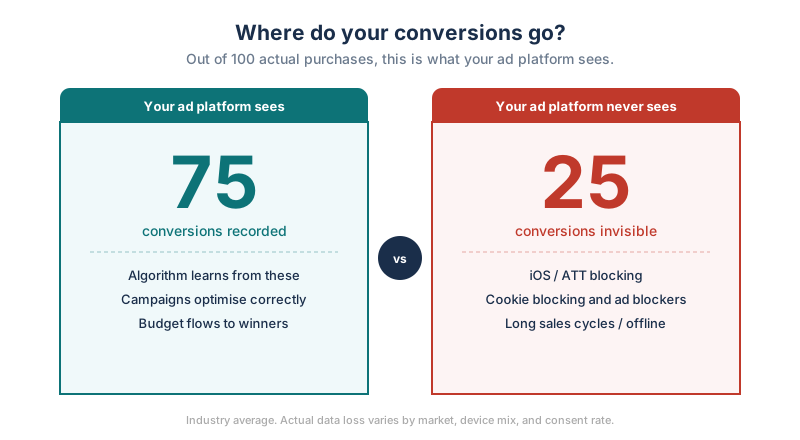
Where your conversions go: 75 recorded vs 25 invisible

This Isn’t Just a Reporting Problem

Here’s where most people misunderstand the cost.

They think: “OK, I’m missing some data. My reports look a little off. I’ll live with it.”

What they’re missing is that this isn’t a reporting problem. It’s a bidding problem.

Meta Advantage+ and Google Performance Max are not passive reporting tools. They’re active bidding algorithms. They decide in real time, for every auction — how much to spend on showing your ad to a particular person.

And they make those decisions based on the conversion data you send them.

When you’re missing 25% of your conversions, the algorithm isn’t just under-reporting. It’s actively learning the wrong things. It’s optimizing based on the customers it can see — which is a biased sample of your actual customer base.

  • Campaigns that look unprofitable but actually work get scaled back
  • Campaigns that look profitable but attract low-value customers get scaled up
  • You’re spending real money based on a fiction the algorithm built from incomplete data

This is what we call the Tracking Gap. And closing it is not about prettier dashboards — it’s about giving your ad AI the full picture so it stops wasting your budget on the wrong bets.

The bidding problem: 75% signal vs 100% signal

How Much Is It Actually Costing You?

Let’s make this concrete.

Say you spend €10,000/month on Meta ads. Your current reported ROAS is 3.0 — for every euro in, you get three back.

Now suppose 25% of your conversions are missing. That means:

  • Your actual ROAS is closer to 4.0 — you’re actually performing better than you think
  • But the algorithm is optimizing toward the 75% of conversions it can see — a biased sample
  • In the worst case, the campaigns with the highest share of invisible conversions look the worst in your account, and are being throttled or turned off

This is the most expensive version of the problem: you’re killing your winners because you can’t see them winning.

Even in a conservative scenario where the data loss just adds noise rather than systematically biasing results — you’re still working with an algorithm that has 25% less signal to learn from. That means slower optimization, higher CPAs, and more budget wasted during the learning phase.

For a €10,000/month account, a 25% reduction in conversion signal can conservatively translate to €1,500–€2,500/month in inefficient spend — campaigns that would perform better if the algorithm had full information.

At €120,000/year in ad spend, that’s potentially €18,000–€30,000 leaving the table annually. Not because your product or targeting is wrong. Because your tracking is incomplete.

Cost of broken tracking: EUR 30k annual waste

Why the Problem Gets Worse Over Time

This isn’t a problem you can wait out.

Each year, browser privacy standards tighten. Apple rolls out new restrictions. Consent rates for cookies in Europe hover around 60–70%, meaning a third of your European visitors are opted out of client-side tracking by default.

The ad platforms know this. Meta and Google have both said publicly that they depend on advertisers sending first-party conversion data via their Conversions API and the Google Ads API to compensate for what the pixel can no longer capture.

In other words: the platforms have already moved on from the pixel. The question is whether your tracking setup has moved with them.

If you’re still relying primarily on browser-side pixel events, the gap between your tracking data and reality grows a little wider every quarter.

What Closing the Tracking Gap Actually Looks Like

The fix is server-side conversion tracking: sending conversion events directly from your server to the ad platform API, rather than relying on a JavaScript pixel firing in the user’s browser.

Digger closes the gap completely:

  • It captures conversions server-side, so iOS restrictions, ad blockers, and cookie blocking cannot prevent the signal from being recorded
  • It doesn’t rely on the browser, so ad blockers and cookie blocking don’t affect it
  • It connects online ads to offline sales via API to your CRM or backend systems

The result in practice: up to 3x ROAS improvements have been observed across multiple customers who switched from pixel-only tracking to Digger. Not because their ads got better. Because the algorithm finally has the full picture.

For businesses with long sales cycles — real estate, finance, B2B SaaS, professional services — Digger also unlocks offline conversion matching: sending the confirmed sale back to the platform weeks or months after the original click, via direct API to your CRM. The algorithm learns which ad actually generated the customer, not just which ad generated a form submission.

GDPR compliance is built into the architecture, not bolted on. Digger processes pseudonymized data server-side, with you as the data controller.

The One Question to Ask About Your Current Setup

You don’t need to understand the technical details to know whether you have a problem.

Ask your team or your agency this: “How are we sending conversion data to Meta and Google — via pixel only, or via server-side API as well?”

If the answer is “pixel only” — or if they’re not sure — you’re almost certainly in the 20–30% loss range.

The cost of fixing it is low. The cost of not fixing it compounds every month.

Want to See Your Numbers?

We can show you in a 30-minute demo exactly how much conversion data your current setup is losing, and what it would mean for your ad spend if you got it back.

Book a free demo →

No pitch deck. No sales pressure. Just your actual data, and an honest conversation about whether server-side tracking makes sense for you.

Related reading: Why server-side tracking gives you a real ad advantage · How Neurogan recovered lost conversions and tripled revenue · Digtective integrations with Meta and Google

What Happens to Your UTM Tags When Users Decline Cookies?

Marketers Love UTM Tags — Here’s Why

UTM parameters are a simple, powerful way to track where your traffic and conversions are coming from. They’re added to links in:

  • Google Ads & Meta campaigns
  • Newsletters
  • Influencer partnerships
  • Affiliate links
  • Organic social posts

When someone clicks a link with UTMs, the parameters (like utm_source, utm_campaign, utm_medium) tell your analytics tool what drove the visit. This allows you to:

  • Track ROI by channel
  • See what campaigns perform
  • Optimize budgets
  • Align marketing and sales

In short: UTMs are the foundation of marketing attribution.
But there’s a silent threat most marketers overlook.

In a perfect world, your analytics tool would remember that someone came from a Google ad — even if they buy a week later.
But we don’t live in that world anymore.

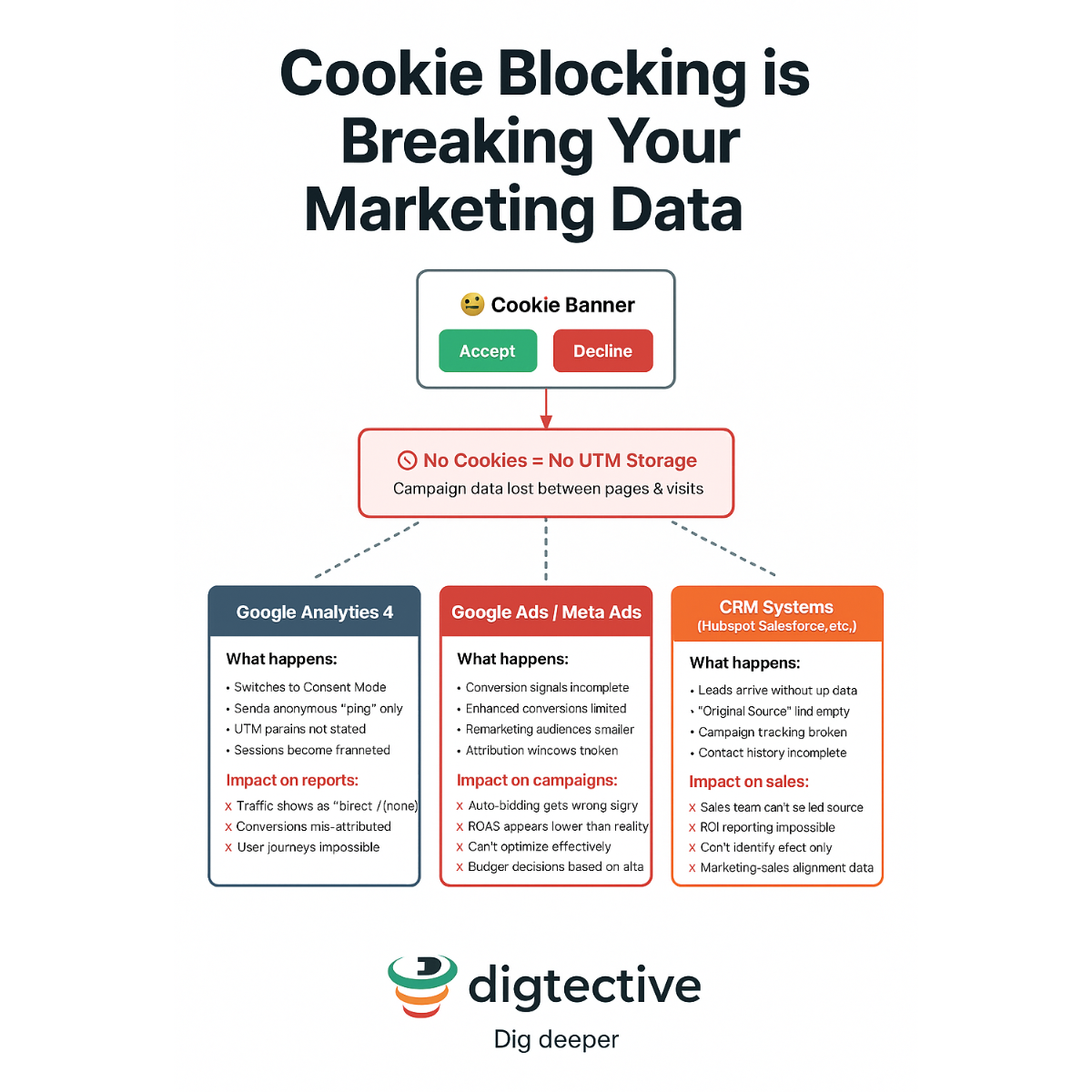
When a user lands on your site, your cookie banner shows up. If they decline, here’s what happens:

  1. No cookies can be stored
  2. No persistent UTM memory
  3. No cross-session attribution

The UTMs may be visible during that first visit, but as soon as they leave the site, the data is gone. If they come back and make a purchase later, analytics will have no idea where they originally came from.
Instead, the sale shows up as:

  1. Direct / None
  2. Unattributed
  3. Invisible to ad platforms

How Big Is This Problem?

This problem is not small. In Europe — where GDPR has been in force the longest — cookie rejection is the norm, not the exceptio

Overall European Behavior (Advance Metrics, 2024):

  1. 40.6% of users actively reject all cookies
  2. 25.4% accept all cookies
  3. 33.6% ignore the cookie banner entirely (which usually results in no consent)


Country-Specific Patterns

  1. Germany and France have the lowest acceptance rates in Europe, with users most likely to reject all cookies.
  2. In Germany, only 1.1% of users engage with detailed cookie settings — the highest rate in Europe.
  3. Switzerland shows just 0.8% engagement with cookie settings.

Device Differences:

  • On mobile, rejection rates skyrocket to 75%, compared to 41% on desktop.
    (Source: Tracking Cookies are Dead: What Marketers Can Do About It)

The Context:

Since GDPR took effect, European users have become far more privacy-conscious than users in the US or Asia. The data shows that between 40% and 75% of European users reject cookies, depending on the device and country.
This makes Europe the toughest region in the world for cookie-dependent analytics. And if your attribution relies on cookie consent, a massive share of your conversions is already going untracked.

What’s the Real Cost to Your Business?

When attribution breaks, the consequences go far beyond your own reporting.

  1. You can’t trust your conversion reports
  2. Profitable campaigns look like they’re underperforming
  3. Ad platforms like Google Ads and Meta receive incomplete data
  4. Their algorithms learn from the wrong signals and optimize in the wrong direction
  5. Budgets get pushed toward underperforming ads, while winning ads lose spend

In other words, it’s not just that you draw the wrong conclusions — your advertising platforms themselves are being misled.

This creates a vicious cycle: bad data → wrong optimization → declining performance → wasted budget.

The real cost is not only missed revenue but also campaigns that actively perform worse over time because the algorithms are trained on false feedback.

The Fix: Cookieless, Server-Side, First-Party Tracking

Here’s the good news: UTM data doesn’t have to disappear.

At Digtective, we’ve built a system that captures and stores UTM parameters without relying on third-party cookies — and in full compliance with GDPR and ePrivacy.

How?

  1. We store UTM parameters server-side when a user arrives
  2. We use short-lived, pseudonymized session IDs
  3. No personal data is collected without consent

Even if the user declines cookies, we can still connect the dots later — when they convert, days or weeks afterward. This means:

  1. 100% attribution — even from long sales cycles
  2. Better ROAS data in Google Ads and Meta
  3. Smarter budget decisions based on true performance
  4. Total compliance with privacy regulations

The Bottom Line

Most marketers are losing up to 30% of their attribution — without realizing it. Your UTM tags are only as good as your ability to store and use them.

If you’re relying on cookie-based analytics, you’re likely:

  1. Under-reporting your results
  2. Feeding poor-quality data to your ad platforms
  3. Making budget decisions with only half the picture

But with Digtective, you can:

  1. Track all conversions (even delayed ones)
  2. Respect user privacy
  3. Optimize with confidence

Ready to See What You’re Missing?

Get a live look at how Digtective can turn invisible conversions into actionable insights — without cookies.


Sources


Surviving and Thriving in a Post‑iOS 26 World: The Marketer’s Guide

We’ve been tracking Apple’s privacy updates closely ever since iOS 14.5 turned Facebook Ads upside down. When iOS 15, 16, and 17 rolled out, we were already helping clients prepare. Now, with iOS 26 about to land, we’ve been digging deep into what’s changing — long before Apple unveils iOS 28.

Why? Because every new release pushes marketers further into the dark. Link tracking gets stripped. Fingerprinting is blocked. Cookies are already dead. And with each update, more of your conversions vanish from your reports.

The result is simple: without a future-proof solution, advertisers lose visibility, waste budget, and miss growth opportunities. However, there is a way to stay ahead. In fact, it’s already available.

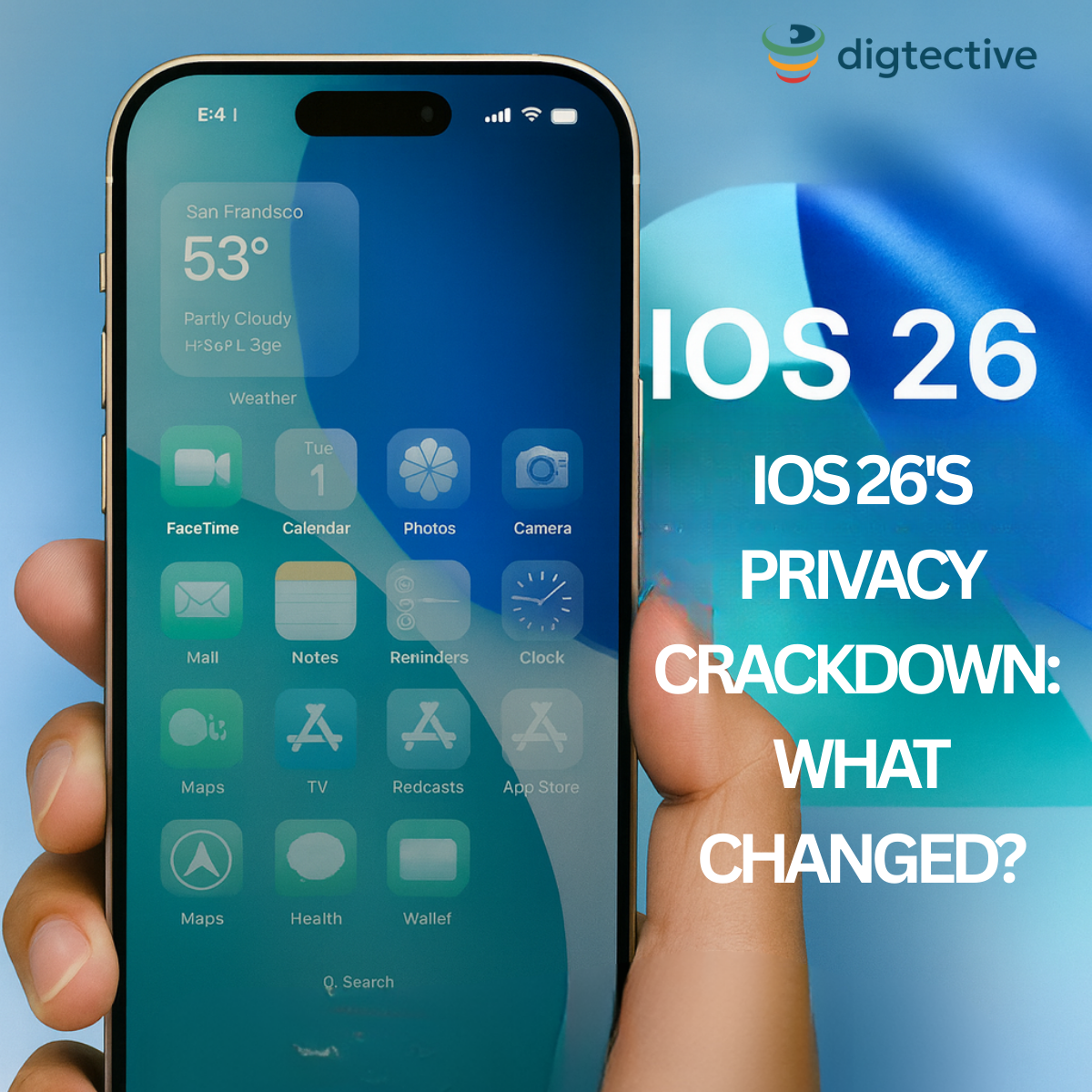
iOS 26’s Privacy Crackdown: What Changed?

Apple has made it clear that tracking users across apps and websites will only get harder. Specifically, two major updates stand out:

  1. Advanced Fingerprinting Protection. Safari now blocks many fingerprinting techniques by default. This applies in both normal and private modes. Device clues like screen resolution, fonts, and CPU cores get scrambled. As a result, they are unreliable for tracking. In short, fingerprinting is going extinct.
  2. Link Tracking Protection. Safari strips tracking parameters from URLs. This happens in Mail, Messages, and Private Browsing. Parameters like gclid, fbclid, and utm_* may never reach your site. Consequently, you lose visibility into the campaign that drove the visit. In turn, this weakens your ability to optimize.

Together, these updates take away the last remnants of traditional tracking. In other words, they close every loophole advertisers once relied on.

Why This Triggers an Attribution Crisis

The impact on marketers is huge:

  1. Conversions go dark. Many brands already lost 20–30% of conversions with iOS 14.5. Now, even more will disappear. For example, up to 40% of your iPhone conversions may be untracked. As a consequence, reports become dangerously misleading.
  2. Ad spend is wasted. As a result, when attribution breaks, marketers often cut campaigns that are actually profitable. False negatives cause budgets to shift away from what’s working. Ultimately, this reduces growth instead of supporting it.
  3. Algorithms weaken. Google Ads and Meta Ads rely on conversion data to optimize. Without enough signals, CPAs rise and ROAS falls. Moreover, algorithms can no longer target your best customers effectively.
  4. Illusion of decline. Campaigns may look weaker simply because reporting is incomplete. In reality, sales still happen, but you can’t see them. In turn, this creates the illusion of poor performance.

Therefore, marketers are left flying blind. Above all, they risk making decisions on broken data.

Legacy Tracking is Dead

Traditional methods no longer work:

  1. Cookies: Safari and Firefox already block third-party cookies. Chrome is phasing them out too. Moreover, even first-party cookies get capped, which shortens attribution windows dramatically.
  2. Click IDs: Apple strips out gclid, fbclid, and similar IDs. As a result, Google Ads and Meta attribution pipelines break. In other words, your ad spend goes uncredited.
  3. Fingerprinting: Safari randomizes device details. Consequently, fingerprinting is no longer a viable workaround.
  4. Device IDs: App Tracking Transparency already killed IDFA for most users. Instead, marketers were pushed toward server-side APIs and SKAdNetwork.

In summary, Apple is dismantling every workaround that tries to follow users without consent. Therefore, a new approach is essential.

How Digger Solves the iOS 26 Challenge

Instead of patching broken systems, Digtective’s Digger takes a new approach.

  1. Server-side tracking. Events are captured directly on your server. This means they bypass browser restrictions and ad blockers. As a result, no conversion gets lost.
  2. No cookies or fingerprints. Digger is 100% privacy-first and GDPR-compliant. Therefore, there is nothing for Safari to block. In addition, compliance teams can sign off with confidence.
  3. Deterministic attribution. Click data is stored server-side, then matched to conversions. As a result, you see exactly which campaign drove the sale. Importantly, this happens without fragile browser IDs.
  4. Platform integrations. Digger pushes conversions back to Google, Meta, and others via server-side APIs. Consequently, algorithms get the full data picture again. In turn, campaign performance improves.
  5. Future-proof. Built for a cookieless world. In fact, it’s ready for iOS 26 and whatever comes next.

Recover Lost Conversions and Maximize ROAS

With Digger, marketers:

  1. Capture 100% of conversions. Even the 30–40% that go dark with iOS are recovered. As a result, you regain full visibility.
  2. Trust their data. Every sale and lead is tied back to the right campaign. Therefore, reporting becomes accurate again.
  3. Optimize with confidence. Budgets go to the campaigns that truly deliver ROI. In addition, wasted spend is cut dramatically.
  4. Feed the algorithms. Google and Meta’s bidding models improve with better data. As a consequence, CPAs drop and ROAS climbs.
  5. Stay compliant. Privacy and performance go hand in hand. Above all, you remain future-proof.

Brands using Digger have cut CPA by up to 80% while scaling leads and revenue. For instance, some saw conversion costs fall by nearly 79% in just three months.

Conclusion: Don’t Let iOS 26 Leave You in the Dark

Apple’s privacy moves are here to stay. Therefore, the only way forward is cookieless, server-side, first-party tracking. That’s exactly what Digger delivers.

👉 Ready to illuminate your “dark” conversions and supercharge ROAS?

Book a demo with Digtective today.

Sources

Boost Your Meta Ads Performance with Digtective’s New Conversion API Integration

Boost Your Meta Ads Performance with Digtective’s New Conversion API Integration

We’re excited to introduce a powerful new feature in Digtective: native support for the Meta Conversion API!

This update allows you to send high-quality conversion events directly from your server to Meta (Facebook), improving attribution accuracy and ad performance—especially in the age of increasing tracking restrictions and iOS privacy changes.

Why This Matters

Traditional browser-based tracking (like the Facebook Pixel) is no longer enough. Browser events can be blocked, delayed, or distorted by ad blockers and privacy settings. With Meta’s Conversion API (CAPI), you can now bypass these limitations by sending conversion data server-side—making it more reliable and more complete.

If you’d like to dig deeper into how iOS updates disrupted Facebook ads tracking—and how Digtective stepped in to help—check out our previous post:

How iOS 14.5 Broke Facebook Ads (and How We Fixed It)

By combining browser-based tracking and server-to-server event transmission, our new CAPI integration helps you:

Recover lost conversions due to browser tracking issues

Improve signal quality for Meta’s ad algorithms

Optimize campaign performance with more accurate data

• Reduce CPA by giving Meta better data to work with

Who Is It For?

This feature is ideal for ecommerce sites using WooCommerce, Shopify, or custom solutions—especially if you’re already using Digtective for tracking and attribution. Now, with just a few extra steps, you can enable CAPI without complex coding or relying on bulky plugins that slow down your load times.

How to Set It Up

We’ve made it simple. Just follow our step-by-step guide:

How to Add Meta Conversion API to Digger

All you’ll need is your Meta Pixel ID and an access token from Meta Events Manager. Once configured, Digtective will send key events like purchases, leads, or other conversions directly to Meta—server-side—while still retaining browser-side tracking for completeness.

Start Getting Better Results Today

Adding Meta’s Conversion API is one of the best ways to increase ROAS and stay competitive in today’s privacy-first ad landscape. And now, it’s easier than ever—thanks to Digtective.

Have questions or want help setting it up? Contact us, and we’ll walk you through every step.

Book a 15-minute Demo & Free Audit

See exactly where your tracking gaps are—and how to fix them.