



You think you’re spending €10,000 a month on ads.
You’re not. You’re spending €10,000 but making decisions based on €7,000 worth of data. The other €3,000 is flying blind.
That’s not a metaphor. It’s what happens when your conversion tracking is broken. And right now, for most businesses running paid ads on Meta or Google, it is broken quietly, invisibly, and in ways that get worse every year.
Here’s what’s actually happening, what it costs you, and what you can do about it.
The Tracking Gap: Why 20–30% of Your Conversions Are Invisible
When someone clicks your ad and converts, a chain of events is supposed to happen: a signal fires, your ad platform records the conversion, and the algorithm learns from it.
But somewhere in that chain, for a significant portion of your customers, the signal never arrives.
The reasons stack up:
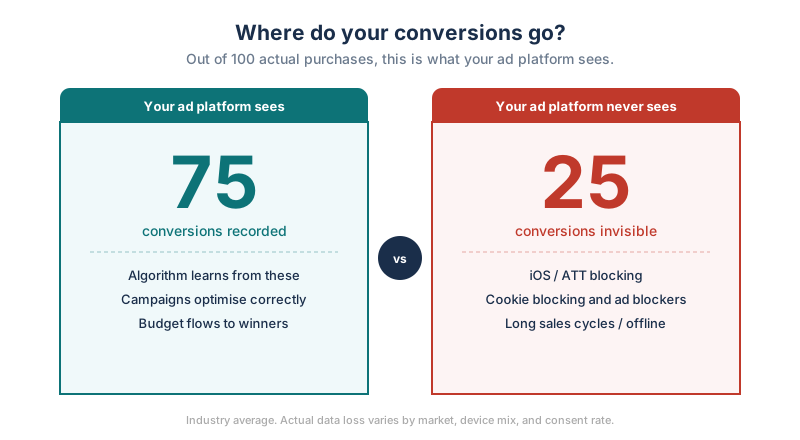
iOS 14.5 and beyond. Apple’s App Tracking Transparency framework, launched in 2021, cut the signal rate for Meta pixel events by an estimated 20–40% for iOS users. And iOS users are not a niche — they are often your highest-value customers.
Cookie blocking and browser privacy settings. Safari has blocked third-party cookies since 2017. Firefox followed. Even Chrome users increasingly use privacy extensions or settings that prevent pixel tracking. The result: a growing share of desktop conversions are also invisible.
Ad blockers. Roughly 27% of internet users run ad blockers, many of which also block tracking pixels.
Long sales cycles. If your customer clicks an ad on Monday and converts on Friday — or in three months — the pixel event fires in a completely different session, or not at all.
Add it up: independent studies and first-party data from tracking platforms consistently show that 20–30% of actual conversions never reach your ad platform. For B2B companies with long sales cycles, or businesses in markets with high iOS usage, that number can exceed 40%.
This Isn’t Just a Reporting Problem
Here’s where most people misunderstand the cost.
They think: “OK, I’m missing some data. My reports look a little off. I’ll live with it.”
What they’re missing is that this isn’t a reporting problem. It’s a bidding problem.
Meta Advantage+ and Google Performance Max are not passive reporting tools. They’re active bidding algorithms. They decide in real time, for every auction — how much to spend on showing your ad to a particular person.
And they make those decisions based on the conversion data you send them.
When you’re missing 25% of your conversions, the algorithm isn’t just under-reporting. It’s actively learning the wrong things. It’s optimizing based on the customers it can see — which is a biased sample of your actual customer base.
- Campaigns that look unprofitable but actually work get scaled back
- Campaigns that look profitable but attract low-value customers get scaled up
- You’re spending real money based on a fiction the algorithm built from incomplete data
This is what we call the Tracking Gap. And closing it is not about prettier dashboards — it’s about giving your ad AI the full picture so it stops wasting your budget on the wrong bets.

How Much Is It Actually Costing You?
Let’s make this concrete.
Say you spend €10,000/month on Meta ads. Your current reported ROAS is 3.0 — for every euro in, you get three back.
Now suppose 25% of your conversions are missing. That means:
- Your actual ROAS is closer to 4.0 — you’re actually performing better than you think
- But the algorithm is optimizing toward the 75% of conversions it can see — a biased sample
- In the worst case, the campaigns with the highest share of invisible conversions look the worst in your account, and are being throttled or turned off
This is the most expensive version of the problem: you’re killing your winners because you can’t see them winning.
Even in a conservative scenario where the data loss just adds noise rather than systematically biasing results — you’re still working with an algorithm that has 25% less signal to learn from. That means slower optimization, higher CPAs, and more budget wasted during the learning phase.
For a €10,000/month account, a 25% reduction in conversion signal can conservatively translate to €1,500–€2,500/month in inefficient spend — campaigns that would perform better if the algorithm had full information.
At €120,000/year in ad spend, that’s potentially €18,000–€30,000 leaving the table annually. Not because your product or targeting is wrong. Because your tracking is incomplete.

Why the Problem Gets Worse Over Time
This isn’t a problem you can wait out.
Each year, browser privacy standards tighten. Apple rolls out new restrictions. Consent rates for cookies in Europe hover around 60–70%, meaning a third of your European visitors are opted out of client-side tracking by default.
The ad platforms know this. Meta and Google have both said publicly that they depend on advertisers sending first-party conversion data via their Conversions API and the Google Ads API to compensate for what the pixel can no longer capture.
In other words: the platforms have already moved on from the pixel. The question is whether your tracking setup has moved with them.
If you’re still relying primarily on browser-side pixel events, the gap between your tracking data and reality grows a little wider every quarter.
What Closing the Tracking Gap Actually Looks Like
The fix is server-side conversion tracking: sending conversion events directly from your server to the ad platform API, rather than relying on a JavaScript pixel firing in the user’s browser.
Digger closes the gap completely:
- It captures conversions server-side, so iOS restrictions, ad blockers, and cookie blocking cannot prevent the signal from being recorded
- It doesn’t rely on the browser, so ad blockers and cookie blocking don’t affect it
- It connects online ads to offline sales via API to your CRM or backend systems
The result in practice: up to 3x ROAS improvements have been observed across multiple customers who switched from pixel-only tracking to Digger. Not because their ads got better. Because the algorithm finally has the full picture.
For businesses with long sales cycles — real estate, finance, B2B SaaS, professional services — Digger also unlocks offline conversion matching: sending the confirmed sale back to the platform weeks or months after the original click, via direct API to your CRM. The algorithm learns which ad actually generated the customer, not just which ad generated a form submission.
GDPR compliance is built into the architecture, not bolted on. Digger processes pseudonymized data server-side, with you as the data controller.
The One Question to Ask About Your Current Setup
You don’t need to understand the technical details to know whether you have a problem.
Ask your team or your agency this: “How are we sending conversion data to Meta and Google — via pixel only, or via server-side API as well?”
If the answer is “pixel only” — or if they’re not sure — you’re almost certainly in the 20–30% loss range.
The cost of fixing it is low. The cost of not fixing it compounds every month.
Want to See Your Numbers?
We can show you in a 30-minute demo exactly how much conversion data your current setup is losing, and what it would mean for your ad spend if you got it back.
No pitch deck. No sales pressure. Just your actual data, and an honest conversation about whether server-side tracking makes sense for you.
Related reading: Why server-side tracking gives you a real ad advantage · How Neurogan recovered lost conversions and tripled revenue · Digtective integrations with Meta and Google


