



Why accurate conversion tracking determines who wins the AI advertising arms race
Here’s an uncomfortable truth: while you’re reading this, your competitors are feeding their advertising data to AI systems that optimise campaigns faster, smarter, and more ruthlessly than any human team ever could. Meta is pushing toward full ad automation. Google’s Performance Max and AI-powered campaigns are rewriting the rules of search advertising. The question isn’t whether AI will transform digital marketing. It already has. The question is whether you’ll be ready to compete.
But here’s what the platform evangelists won’t tell you: AI is only as good as the conversion data you feed it.
The shift to AI automation in Google and Meta ads
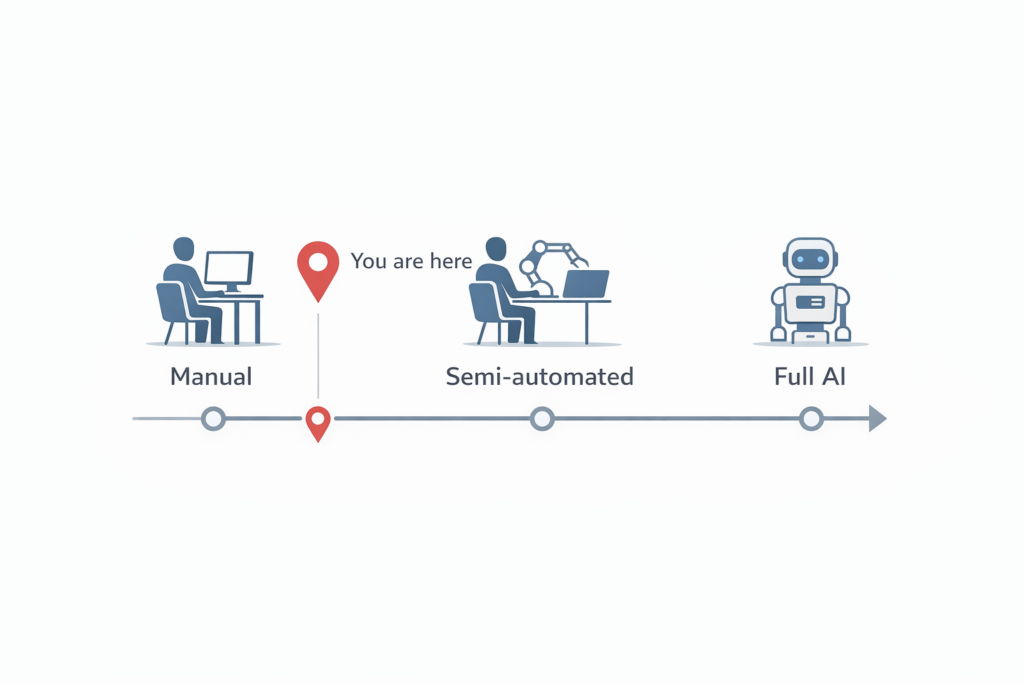
The industry is rapidly moving toward full automation. Meta has signalled that advertisers will soon be able to launch campaigns by simply inputting a business URL and budget. Their AI will handle everything else: creative generation, audience targeting, automated bidding, and performance analysis. No manual setup. No creative briefs. No media buyers required.
Google’s trajectory is similar. Performance Max already uses machine learning to deliver ads across Search, Display, YouTube, and Gmail from a single campaign. Their newer AI-powered features combine broad match targeting with generative AI to automate targeting, bidding, and creative customisation. The platform no longer waits for your keyword lists. It predicts user intent and matches your ads to searches you never thought to target.
These aren’t incremental improvements. They represent a fundamental shift in how digital advertising works. The platforms are building systems designed to outperform human campaign managers at every level of the funnel.
And they’re getting results. Google reports that advertisers using AI-powered Search campaigns see up to 14% more conversions compared to standard setups. Performance Max campaigns drive 27% more conversions at similar cost-per-acquisition. Meta’s AI-driven Advantage+ suite has fuelled explosive ad revenue growth, with the company now capturing 45 cents of every incremental advertising dollar spent online.
Why AI fails: the hidden cost of bad conversion data
Here’s where most businesses get it catastrophically wrong.
They hear “AI optimisation” and assume the technology will fix their campaigns. They enable Performance Max, activate Advantage+, and wait for the magic to happen. But the magic never comes. Or worse, it comes with devastating side effects.
The principle is as old as computing itself: garbage in, garbage out. Feed an AI system flawed conversion data, and it will optimise toward flawed outcomes with ruthless efficiency. The smarter the AI, the faster it scales your mistakes.
And here’s the problem: most advertisers are feeding their AI absolute garbage.
The signal loss problem
Since iOS 14.5 dropped in 2021, the digital advertising ecosystem has been flying increasingly blind. Apple’s App Tracking Transparency framework decimated Meta’s pixel tracking. Cookie consent banners now block 30-40% of conversions from ever being recorded. Browser privacy updates have made cross-device attribution modelling nearly impossible.
The result? The conversion data flowing into Google and Meta’s AI systems is systematically incomplete. And not randomly incomplete. Selectively incomplete in ways that skew toward certain demographics, devices, and behaviours.
When Performance Max optimises based on this distorted signal, it doesn’t find your best customers. It finds the customers whose conversions happen to be trackable. These are often very different groups.
This is the core of the ROAS accuracy problem. Your reported return on ad spend doesn’t reflect reality. It reflects the subset of reality your tracking can see.
What bad conversion tracking actually costs you
We’ve analysed hundreds of ad accounts across e-commerce, lead generation, and B2B verticals. The pattern is consistent and sobering.
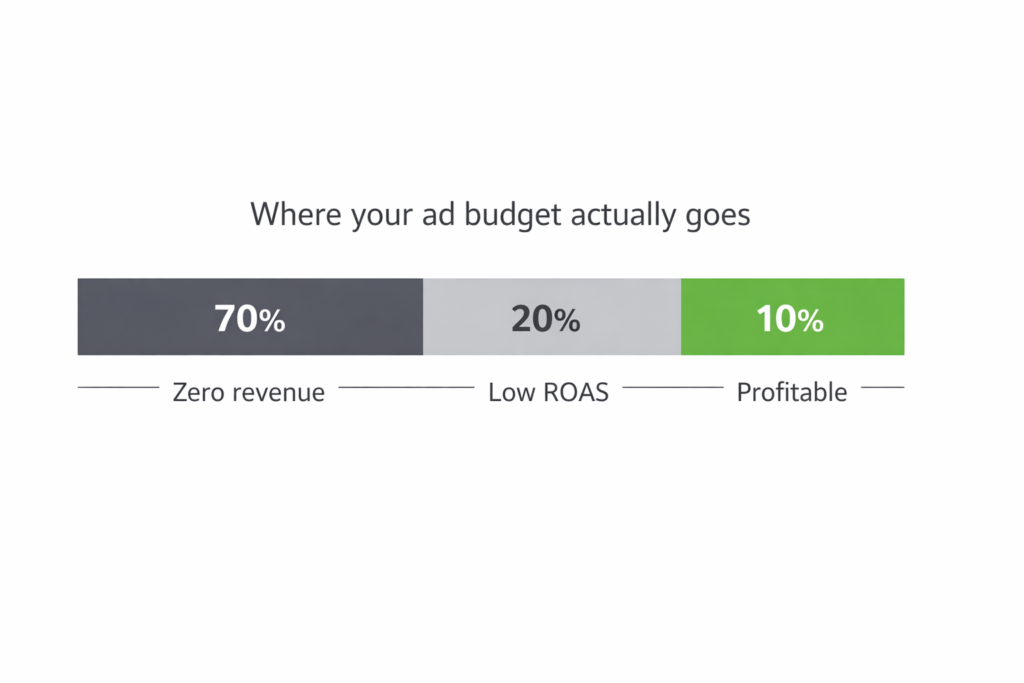
Typically, 50-70% of advertising spend generates zero attributed revenue.
Not low ROAS. Not marginal returns. Zero. Meanwhile, a small subset of campaigns, often less than 10% of total spend, delivers extraordinary returns that get diluted by the underperformers.
One health products company we analysed had Google Ads reporting positive ROAS across all campaigns. Standard analytics painted a rosy picture. But when we implemented first-party conversion tracking and traced actual revenue back to ad spend, the reality was stark: most of their budget was haemorrhaging money, while a handful of campaigns were generating exceptional returns that the averages concealed.
The AI wasn’t broken. It was optimising exactly as designed, toward the incomplete, misleading signal it was receiving.
The competitive advantage no one talks about
This creates an unusual competitive dynamic.
Most advertisers are racing to adopt the latest AI features without addressing their foundational data problems. They’re building sophisticated houses on crumbling foundations.
The winners in this environment won’t be those who adopt AI fastest. They’ll be those who feed it the cleanest signal.
Think about what happens when you can track 100% of conversions while your competitors capture only 60-70%. Your AI optimisation starts with a 30-40% information advantage. Over time, this compounds. Your campaigns learn faster. Your targeting gets sharper. Your creative tests yield clearer insights. You can cut losers sooner and scale winners harder.
In the AI era, conversion tracking accuracy isn’t just a technical concern. It’s a competitive moat.
How first-party conversion tracking fixes AI optimisation
The path forward isn’t to resist AI. It’s to give it what it needs to actually work.But first, let’s understand why this problem exists in the first place.
How traditional tracking works (and why it breaks)
When someone clicks your Google or Meta ad, the platform drops a cookie in their browser and fires a tracking pixel. When that person later converts on your website, the pixel reads the cookie and reports the conversion back to the ad platform. Simple enough.
Except it no longer works.
iOS 14.5 introduced App Tracking Transparency, which blocks cross-app tracking by default. Over 80% of iPhone users opt out. Safari and Firefox block third-party cookies entirely. Chrome is phasing them out. Meanwhile, roughly 30% of users run ad blockers that prevent tracking pixels from firing at all.
And then there are cookie consent banners. Under GDPR, users must actively consent to tracking cookies. Many don’t. When they decline, your pixel can’t connect their conversion back to the original click.
The result: a significant portion of your actual conversions simply disappear from your data. Google and Meta never learn about them. Their AI optimises based on incomplete information.
What first-party tracking actually means
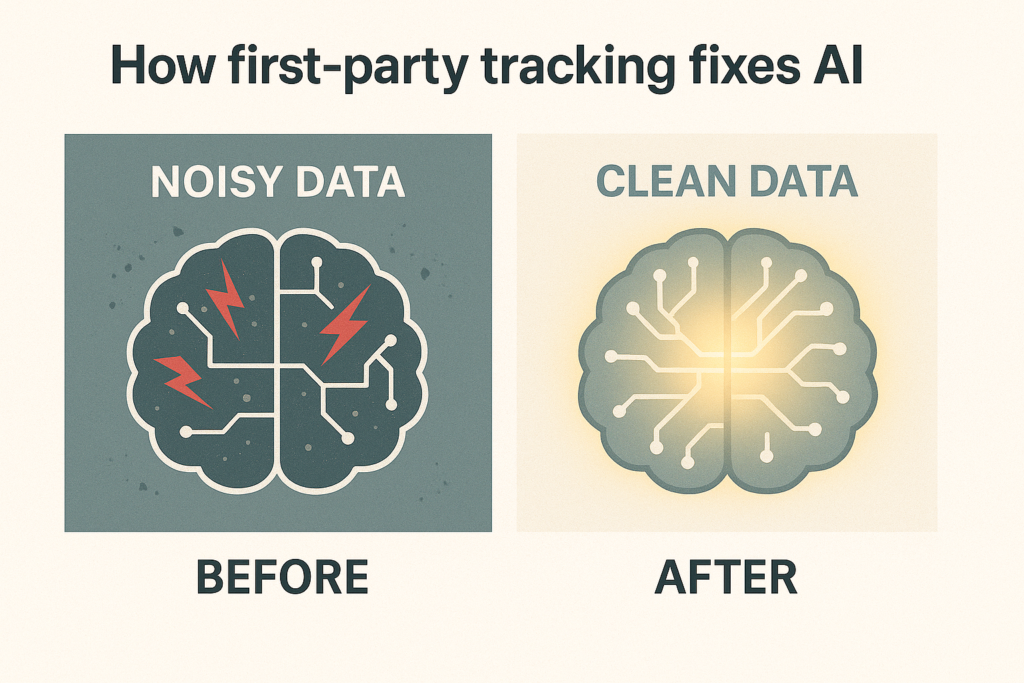
First-party tracking flips the model. Instead of relying on browser cookies and client-side pixels that can be blocked, first-party tracking captures data server-side, on your own infrastructure.
When a visitor arrives from an ad click, first-party tracking stores the source information (campaign, ad group, keyword) in your own system. When they convert, whether immediately, next week, or three months later, you match that conversion to the original source using your own first-party data. No cookies required. No pixels to block.
You then feed this accurate conversion data back to Google and Meta via their conversion APIs. The platforms receive complete information about what actually drives revenue, and their AI can finally optimise toward real business outcomes.
This isn’t about circumventing privacy. It’s about accurate measurement using your own first-party relationship with your customers, fully GDPR compliant, while giving the ad platforms the signal they need to work properly.
- 100% conversion accuracy: Every sale, lead, and action tracked, including iOS users and cookie-decliners that pixel tracking misses completely
- Source-to-sale attribution: Connect every conversion back to the exact campaign, ad group, and keyword that drove it. Know precisely which Google Ads keywords generate revenue and which ones waste budget
- GDPR compliant by design: First-party, cookieless tracking that respects privacy regulations. No consent banner dependency, no compliance risk
- Offline conversion support: Track revenue that happens days, weeks, or months after the click. No 90-day cutoff like standard platform tracking
- Better AI training data: Feed Google and Meta’s algorithms complete, accurate conversion data so they optimise toward actual profit, not vanity metrics
When you can see that keyword X generates €47 per conversion while keyword Y generates €3, your decisions become obvious. Cut Y, scale X, and watch your AI optimise toward actual profit instead of guesswork.
The results speak for themselves
We’ve seen businesses reduce cost per lead by 79% within three months of implementing accurate conversion tracking. Others have tripled revenue without increasing ad spend. One real estate finance company increased leads by 84% while reducing cost per acquisition by 86%.
The pattern is consistent: fix the conversion data, and the AI finally delivers on its promise.

The clock is ticking
The platforms are accelerating toward full automation. Every month you wait is a month your competitors are training their AI systems on better data while yours learns the wrong lessons.
The businesses that will dominate digital advertising in the coming years are making their data infrastructure decisions now. They understand that AI isn’t magic. It’s a multiplier. And multipliers work in both directions.
Multiply accurate data, and you get exponential improvement. Multiply garbage, and you get expensive garbage at scale.
The question you need to answer
Your competitor has AI. Or they’re getting it soon. The platforms are making sure of that.
The real question is: when their AI and your AI are both fully optimised, which one will be learning from better conversion data?
That’s the only advantage that actually matters now.
Ready to see what accurate conversion tracking can do for your campaigns?


