



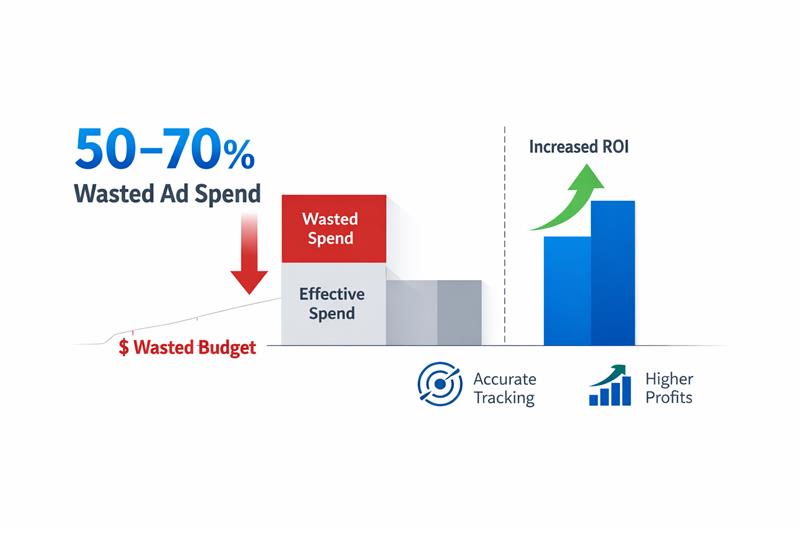
Last month, an e-commerce company discovered they were spending $45,000 monthly on Google Ads keywords that generated zero sales. Not low ROI. Not break-even. Literally zero attributed revenue.
Their dashboard said everything was fine. Google reported healthy conversion numbers and a respectable ROAS. The problem? Their tracking was broken.
And they’re not alone.
The Problem No One Talks About
- Your conversion tracking is probably missing 50-60% of your actual sales right now.
- Every time someone on an iPhone buys from your ad, there’s a good chance you don’t see it. Cookie consent banners, privacy settings, iOS 14.5 restrictions, ad blockers – they all hide your real results from you. So you make decisions in the dark
- You pause campaigns that actually drive revenue
- You scale campaigns that lose money
- You trust dashboards that show incomplete data
The average business wastes 50 to 70% of their ad budget this way. Every single month.
What Happens When You Finally See the Truth
We analyzed advertising data for three companies after implementing 100% accurate, cookieless conversion tracking. Then we used AI to process thousands of data points and identify what was actually working versus what was burning money.
Here’s what we found.
Case Study #1: E-commerce Health Supplements
The Situation
- Monthly Google Ads spend: $67,000+
- Google’s reported ROAS: 4.75 (looked profitable)
- Problem: Revenue wasn’t growing with increased ad spend
What AI Analysis Revealed
When we tracked every conversion with 100% accuracy, the numbers looked completely different:
| Metric | Google Reported | Actual Reality |
| Conversions | 6,568 | 1,833 (only 20% of total) |
| Revenue from Google Ads | $374,000 | $124,981 |
| True ROAS | 4.75 | 1.85 |
But here’s the real discovery: 67% of their search terms generated zero attributed revenue.
They were spending $45,000 per month on keywords that never converted. Not occasionally. Never.
Meanwhile, their “Referral/Other” channel—which received almost no budget—was actually driving 44% of all revenue. Google Ads was getting credit (and budget) for sales it didn’t generate.
The Results
Armed with accurate data and AI-driven insights, they made three changes:
- Cut 70% of Google Ads budget from zero-revenue keywords
- Reallocated $45,000/month to the high-performing referral channel
- Doubled down on the 33% of keywords with proven ROAS
Outcome: – Profitability doubled while maintaining revenue – $45,000+ monthly savings from eliminated waste – Referral channel scaled from 44% to 60% of conversions – 2-3 weeks of manual analysis now automated to hours
Case Study #2: Scandinavian Fashion Brand
The Situation
- Fixed monthly budget: $35,000 (Google Ads + Meta)
- Problem: Revenue had plateaued despite consistent spend
- Suspicion: Campaigns were inefficient, but couldn’t prove which ones
What AI Analysis Revealed
The AI uncovered a systematic misallocation problem:
- 40% of campaigns generated zero revenue → Wasting $14,000/month
- Meta showed 300 conversions, actual number: 45 (85% tracking gap)
- Top-performing keyword had 8.9x ROAS → Receiving only 5% of budget
- 3 campaigns drove 80% of profit → Receiving only 30% of budget
They were optimizing based on platform metrics that had no correlation with actual revenue.
The Results
They reallocated their $35,000 monthly budget based on actual profitability:
- Paused all zero-revenue campaigns ($14,000 freed up)
- Tripled budget on the 8.9x ROAS keyword (from $1,750 to $5,250)
- Reallocated remaining budget to proven winners
- Implemented weekly AI performance reviews
Outcome: – 100% sales growth with the same $35k budget – Setup completed in less than one day – Monthly profitability increased 140% – Customer acquisition cost reduced 47%
Case Study #3: B2B Software Comparison Platform
The Situation
- Monthly spend: $245,000 across Google Ads
- Problem: Revenue wasn’t scaling linearly with increased spend
- Question: Why were some software categories profitable and others weren’t?
What AI Analysis Revealed
The company was treating all software categories equally, but profitability varied dramatically:
| Category | Monthly Spend | ROAS | Status |
| ERP Systems | $92,330 | 3.50 | Highly Profitable |
| CRM Systems | $45,000 | 4.46 | Highly Profitable |
| Accounting Software | $23,000 | 2.68 | Profitable |
| HR Software | $15,670 | 0.85 | Loss Making |
| Marketing Tools | $28,000 | 0.23 | Severe Loss |
| Project Management | $18,000 | 0.45 | Loss Making |
| Other Categories | $23,000 | 0.60 | Loss Making |
Strategic discovery: Three categories (ERP, CRM, Accounting) generated 92% of profit while consuming only 65% of budget. Four other categories collectively lost $46,000 monthly.
The company had achieved category authority in specific verticals but was subsidizing exploratory campaigns that would never be profitable at scale.
The Results
Based on AI recommendations:
- Paused all loss-making categories (freed up $84,670/month)
- Doubled budget on ERP Systems while maintaining ROAS
- Increased CRM budget by 50% to capture market opportunity
- Allocated remaining budget to testing adjacent categories one at a time
Outcome: – Blended ROAS improved from 2.08 to 3.4 – Monthly profit increased by $95,000 – Same revenue maintained with 35% less spend – Clear strategic direction for category expansion
The Pattern Across All Three Cases
These aren’t isolated examples. They represent a consistent pattern we see across every business we analyze:
Common Problems
- 50 to 70% of ad spend funds campaigns with zero attributed revenue
- Platforms credit “winning” campaigns that actually lose money
- Hidden channels drive 80%+ of real revenue without recognition
- Teams spend 2-3 weeks on analysis that AI completes in hours
Typical Results
- 70% budget reduction with profitability doubling
- 100% to 140% profit increases without spending more
- Setup completed in less than one day
- Continuous monitoring instead of quarterly reviews
Why This Matters Now
Your competitors who have solved the data problem now have a decisive advantage.
They know exactly which ads make money. They scale winners with confidence. They reallocate budget from losers instantly. They make decisions in hours that used to take weeks.
This isn’t about spending more on advertising. It’s about knowing the truth about your current spend.
The businesses in this report didn’t increase budgets—they reallocated them based on actual profitability data.
How It Actually Works
Traditional advertising analytics have been broken since iOS 14.5 and GDPR. Most businesses optimize campaigns based on incomplete data, often making decisions that hurt profitability.
The solution requires two components working together:
1. 100% Accurate, Cookieless Tracking
Server-side, cookieless tracking captures every conversion—even when users block cookies, use private browsing, or browse on iOS devices.
This isn’t an estimate or model. It’s 100% accurate attribution of every purchase or lead to its originating campaign, ad, and keyword.
Technical advantages: – Works in post-iOS 14.5 environment – GDPR and privacy-law compliant – No data loss from ad blockers or cookie consent – Granular attribution to keyword/ad level
2. AI-Powered Performance Analysis
With complete data in place, AI processes thousands of data points instantly to identify patterns, anomalies, and opportunities.
The system analyzes every campaign, ad group, keyword, and channel against actual revenue—not proxy metrics like clicks or platform-reported conversions.
What AI identifies: – Campaigns with zero attributed revenue (often 50 to 70% of budget) – Keywords with exceptional ROAS (400%+ returns) – Attribution gaps between channels – Positioning problems (low brand-search conversion rates) – Hidden winner channels receiving no credit
Why Both Components Matter
Without accurate conversion data, AI analysis is worthless. You’re just automating decisions based on incomplete information—garbage in, garbage out.
You need both: the foundation (100% accurate tracking) AND the intelligence layer (AI analysis) to make data-driven optimization actually possible in 2025’s privacy-first advertising landscape.
What You Can Do Right Now
If you’re spending $10,000+ monthly on Google Ads, Meta campaigns, or other digital advertising, there’s a high probability you’re experiencing the same issues as the companies in this report.
The question isn’t whether you’re wasting budget. The question is how much.
Three Options:
Option 1: Do Nothing Continue optimizing based on incomplete data. Keep funding campaigns that might not generate revenue. Hope your competitors don’t figure this out first.
Option 2: Manual Analysis Spend 2-3 weeks manually analyzing your conversion data. Attempt to identify patterns across thousands of data points. Repeat quarterly.
Option 3: Implement Accurate Tracking + AI Analysis Get the same foundation these three companies used. See exactly which campaigns drive revenue. Let AI identify opportunities and waste automatically.
Download the Complete Case Study (Free)
Want the full analysis including: – Complete methodology and technical implementation – Detailed breakdown of all three case studies – Step-by-step framework for identifying waste – AI analysis approach and recommendations – Common patterns across 15+ businesses
No credit card required. Instant access.
The Bottom Line
One client found $540,000 in yearly waste. Another doubled sales overnight. A third increased profit by $95,000 monthly.
Same ad budgets. Same teams. Same products.
The only difference? They finally saw where their money was actually going.
Your tracking is broken. Your competitors are fixing theirs.
What are you going to do about it?
About Digtective
Digtective provides 100% accurate, cookieless conversion tracking combined with AI-powered analysis for e-commerce businesses and B2B companies. We help businesses discover which campaigns actually drive revenue and which ones waste budget.
Ready to know the truth about your ad spend?
📧 Email: post@digtective.com
🌐 Website: digtective.com
Published: January 2026


